S/PDIF Analyzer

Blind listening tests

S/PDIF cables: what blind listening tests show

Can a digital cable change the sound? Five studies run without listeners knowing what they were hearing, from 1990 to 2015, shed light on the question: jitter audibility thresholds, CD format, sources and digital cables. Here are their results in brief, with their limits.

By Julien G. Primary sources cited for every study.

Key points

The results at a glance

StudyQuestionPanelResultConclusion
Ashihara & al. 2005 Random jitter threshold23 listeners0 of 23 at 250 ns, 23 of 23 at 2 µsInaudible at 250 ns
Benjamin & Gannon 1998 Jitter injected on S/PDIF9 subjects (tone), 8 trained subjects (music)10 ns (20 kHz tone), 20 to 370 ns (chosen excerpts)Rarely audible with music
Meyer & Moran 2007 CD quality vs high resolution554 trials49.8 % correctNo audible difference
Stereophile 1990 Two CD sources, cables included461 listeners, 3,222 trials48.3 % correctChance result
Ars Technica 2015 $340 vs $2.50 Ethernet cable7 people6 of 7 failedNo difference, rough protocol

2005

Jitter: none of the 23 listeners hears it at 250 ns

23 experienced listeners, each at home, on their own system and music. Jitter was audible to all of them at 2 µs, to 6 out of 23 at 500 ns, and to none at 250 ns.

0 of 23listeners detected 250 ns of jitter

Method
Forced choice between two versions of the same excerpt, with free switching. Random jitter added to the data at several levels.
Verdict
The threshold sits several thousand times above what a good 10 m coaxial cable adds (0.05 ns peak to peak without noise for a Belden 1694A in the simulator).
Limits
Jitter simulated in the file, not produced by a real cable.

Kaoru Ashihara, Shogo Kiryu, Nobuo Koizumi, Akira Nishimura, Juro Ohga, Masaki Sawaguchi, Shokichiro Yoshikawa. Acoustical Science and Technology, vol. 26, no. 1, pp. 50-54, 2005. doi.org/10.1250/ast.26.50
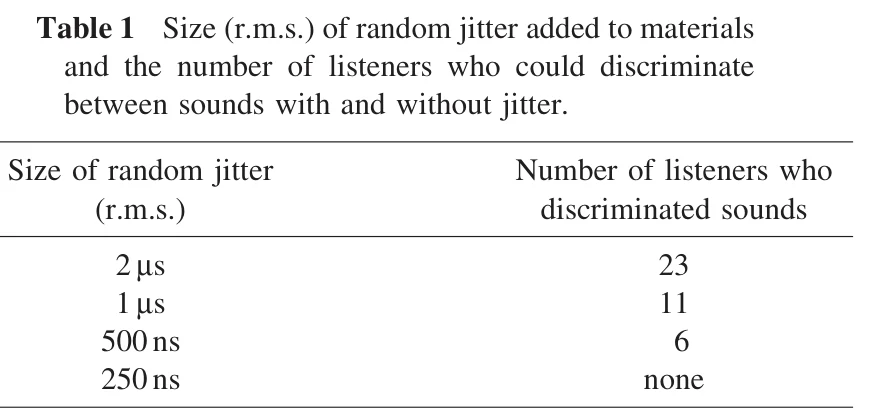
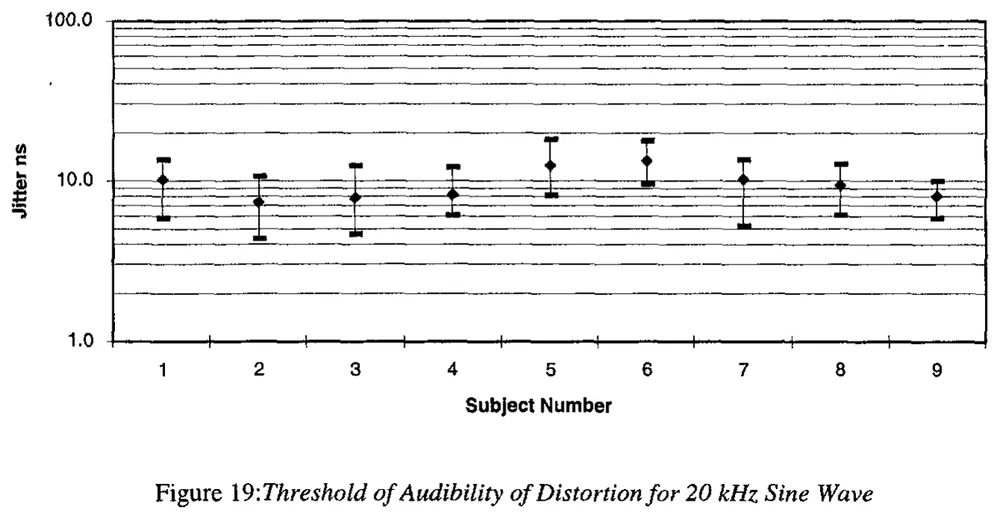
Table 1 of the study: size of random jitter and number of listeners who detected it
Table 1 of the paper: random jitter added (r.m.s.) and number of listeners, out of 23, who told the sounds with and without jitter apart. Source: K. Ashihara et al., Acoustical Science and Technology 26(1), 2005, doi.org/10.1250/ast.26.50.

1998

At Dolby, jitter injected on S/PDIF stays hard to hear in music

Sinusoidal jitter injected straight onto an S/PDIF link, heard on headphones. On a pure 20 kHz tone with 17 kHz jitter, the worst case, the average threshold drops to 10 ns. On music excerpts chosen to be revealing, it takes between 20 and 370 ns depending on the subject.

10 nsaverage threshold in the worst case (20 kHz tone, 17 kHz jitter)

Method
Thresholds measured on headphones, first on tones (9 subjects), then on music excerpts chosen to be revealing (8 trained subjects).
Verdict
The authors conclude that most music programmes do not make jitter audible at typical levels.
Limits
Small panel; thresholds on music set by the listeners themselves.

Eric Benjamin, Benjamin Gannon (Dolby Laboratories). AES 105th Convention, preprint 4826, San Francisco, 1998. AES e-library

Figure 19 of the study: jitter audibility threshold on a 20 kHz tone, per subject
Figure 19 of the paper: audibility threshold on a 20 kHz tone, in nanoseconds of jitter (log scale), for each subject. Source: E. Benjamin and B. Gannon, AES preprint 4826, 1998, AES e-library.

2007

CD quality slipped into high resolution: 49.8 % correct

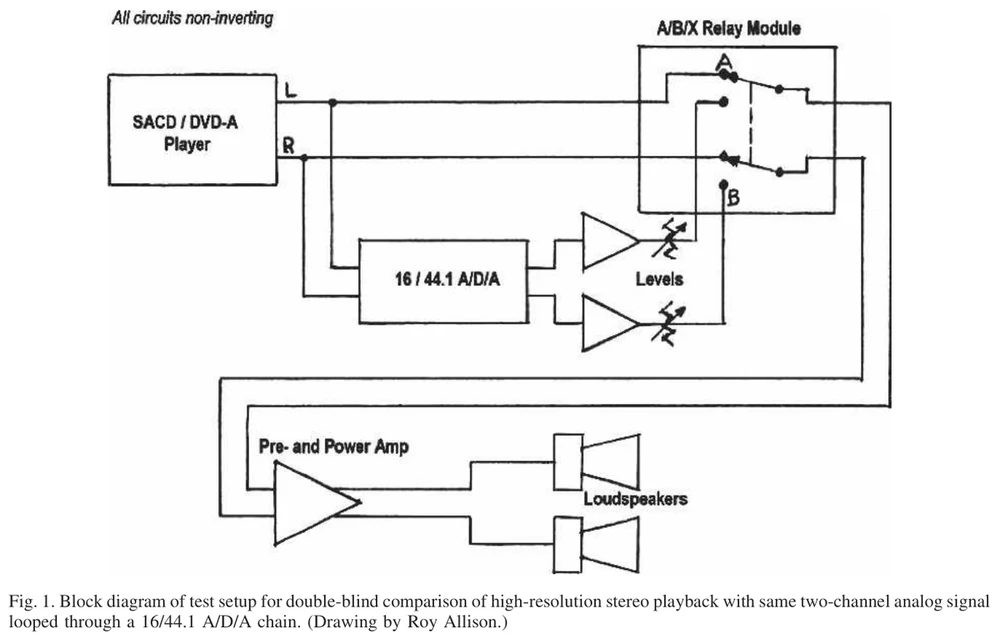
For over a year, listeners, recording engineers among them, tried to spot a 16-bit / 44.1 kHz loop inserted into SACD or DVD-Audio playback. Result: 276 correct answers out of 554, pure chance.

276 / 554correct answers, i.e. 49.8 %

Method
Double blind on several systems, including a high-end installation.
Verdict
A full CD-format conversion cannot be heard at normal listening levels. The one exception: background noise, in silence with the gain turned up.
Limits
Tests the format, not a cable.

E. Brad Meyer, David R. Moran (Boston Audio Society). Journal of the Audio Engineering Society, vol. 55, no. 9, pp. 775-779, 2007. AES e-library

Figure 1 of the study: block diagram of the double-blind test setup
Fig. 1 of the paper: the A/B/X relay inserts, or not, the 16-bit / 44.1 kHz loop between the SACD or DVD-Audio player and the amplifier. Source: E. B. Meyer and D. R. Moran, J. Audio Eng. Soc. 55(9), 2007 (drawing by Roy Allison), AES e-library.

1990

New York show: 461 visitors can't tell two CD sources apart

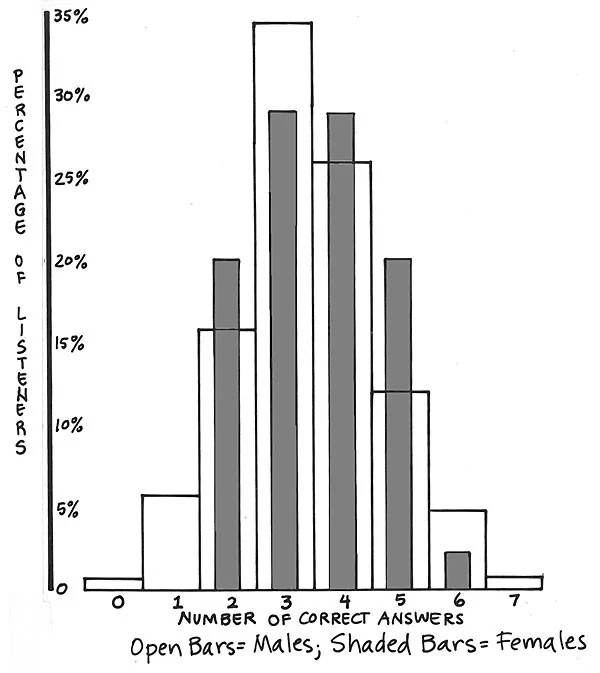
A Philips transport and an ordinary digital cable against an Esoteric transport, a treated disc and a high-end cable, into the same converter. Across 3,222 trials, 48.3 % correct.

48.3 %correct across 3,222 trials

Method
Public single-blind test (the operator knew the source), New York hi-fi show, April 1990.
Verdict
No group of listeners did significantly better than chance.
Limits
Several things changed at once; Stereophile itself calls the result ambiguous.

John Atkinson, with Will Hammond. Stereophile, November 1990 ("CD Tweaks & Listening Tests"). stereophile.com

Histogram from the study: share of listeners by number of correct answers out of 7
Fig. 1 of the article: share of listeners by number of correct answers out of 7 (open bars: men; shaded: women). The distribution is centred on chance. Source: J. Atkinson and W. Hammond, Stereophile, November 1990, stereophile.com.

2015

A $340 Ethernet cable against a $2.50 one

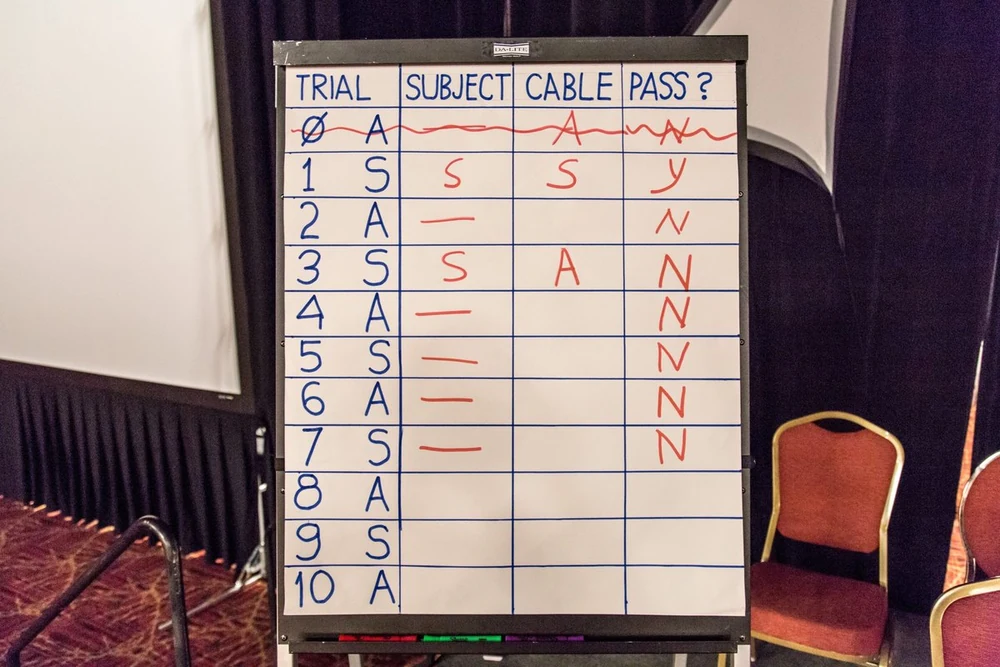
In Las Vegas, with the James Randi Educational Foundation, an AudioQuest Vodka Ethernet cable faced a budget cable in an ABX test on headphones. 6 out of 7 people could not pick the expensive cable, in a rough test that its author calls inconclusive.

6 of 7participants failed to identify the $340 cable

Method
Public A/B/X test on stage (The Amazing Meeting, Las Vegas), headphone listening. Only the cable between the switch and the computer changes; the music comes from a network drive. The listener knows A and B; X is drawn at random and plugged in behind a curtain by operators who know which cable is connected. One trial per person; "no difference" is allowed and counted as a miss. Criterion set in advance: 15 hits out of 20, stop after 6 misses.
Verdict
The only blind test we found where a digital cable is the only variable shows no audible difference. It concerns an Ethernet cable: the data go through a buffer, with no clock carried, so it is not an S/PDIF link.
Limits
Stopped after 7 people: 1 correct answer, 1 wrong, 5 heard no difference. Biases acknowledged by the author: an audience of skeptics told in the opening talks that such cables are pseudoscience; only one network leg tested; the "no difference" answer invalidates the probability calculation, as the statistician admitted afterwards; one trial per person. An Ethernet cable, not S/PDIF; the author himself calls the conclusion weak.

Lee Hutchinson. Ars Technica, 30 July 2015. arstechnica.com

ABX test scoreboard: only the first trial passed
The scoreboard at the end of the test, as published by Ars Technica: only the first trial passed. Source: photo by Lee Hutchinson, Ars Technica, 2015, arstechnica.com.

Why test blind

Two 1991 reviews put these results in context. David Clark (AES preprint 3167) sums up ten years of ABX testing: many differences heard in sighted listening vanish once the listener no longer knows what is playing.

Tom Nousaine (AES preprint 3177) shows that listeners readily describe a difference between two strictly identical sources. Without blinding or control trials, a test overstates the differences.

A negative result does not prove a difference is inaudible to everyone. It does give an order of magnitude: what a digital cable adds stays far below the known thresholds. The simulator lets you check it cable by cable.

Compare two cables in the simulator